



Welcome to the latest edition of Capital Efficient - let’s get into it.
Weekly Radar
The State of Enterprise (Open)AI
OpenAI released their State of Enterprise AI report this week. While in part a marketing document, it still has some good nuggets. The cliche about the future being unevenly distributed continues to hold true: AI adoption varied wildly across industries. Tech industry adoption of AI-coding was off the charts and should almost be viewed separately, but healthcare and manufacturing weren’t far behind, each seeing a 7-8x YoY spike in usage among OpenAI customers.
One caveat - this data set only applies to a subset of OpenAI’s enterprise customers - no API data is included, so lawyers accessing OpenAI via Harvey or bankers accessing it via Hebbia don’t show up here. Still an interesting graphic.
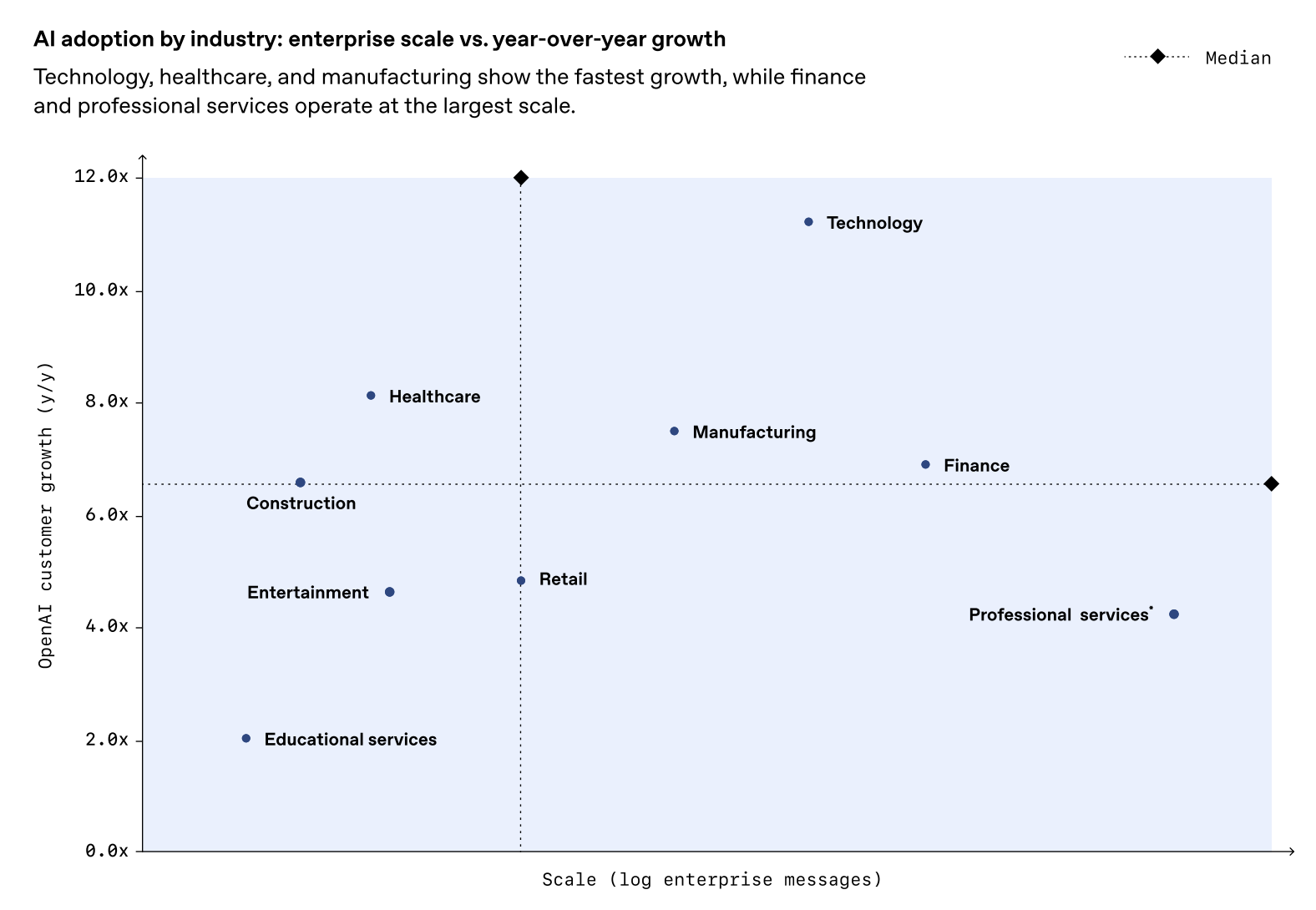
Educational services was the biggest laggard, and slow growth in professional services stood out, though I suspect that’s a methodology issue.
Two other fun facts:
The UK and Germany are the largest ChatGPT Enterprise markets outside the US by customer count.
Japan has the largest number of corporate API customers outside the US.
As OpenAI goes global, I wonder if being early in the Japan/Germany/etc. OAI office ends up having similar cache that having been part of an Uber geographic launch team used to carry. Read the whole thing here.
Homebrew Software Raises The Bar For The Pros
Over the last few weeks, a number of stories about white collar professionals vibe coding custom software have gone viral, accompanied by the (incorrect) take that vertical AI is dead because users will build their own tools instead of buying off the shelf. One such example: a lawyer who built their own case management platform.
No doubt ambitious, semi-technical professionals are experimenting with Claude Code, Lovable, and others to see what they can jury-rig together. But that doesn’t mean homebrew software will replace the role vertical software plays within industry.
I tend to agree with the standard pushback from vertical investors who aren’t ready to write off their portfolios to a future where every worker becomes a vibe coder. The counterargument is usually threefold:
This homebrew software will break and there’s no one to maintain it.
It won’t be compliant with any security frameworks, meaning IT will block its deployment.
Building this software is a bad use of the firm’s time. They should focus on their core competency.
All fair points. But the rise of in-house AI tools should still matter to vertical AI founders (and investors). With some workers building their own “verticalized” systems - and all workers increasingly turning to foundation models for task assistance - the bar for what a vertical AI platform needs to do to be interesting and command a healthy ACV is getting higher.
If you can solve the same workflow with ChatGPT/Claude, or if someone ambitious on the team can use AI to build an internal tool that solves the same problem a vertical AI startup is using as their wedge, it gets challenging to convince buyers to allocate budget to your product.
So how do vertical AI companies stay ahead of the ambitious associate with a Claude Code subscription? The moat comes from orchestrating complex, multi-step workflows that would take months to replicate in a homebrewed tool, data flywheels that get smarter with every customer interaction, deep integrations with unfriendly systems of record, and real domain expertise baked into product by default. The bar is higher, but there are still many ways for vertical AI to win and to build defensibility over time.
Deals
Unconventional AI raised a $475MM Seed round this week. They knew exactly what they were doing calling a half-billion dollar financing a “Seed” - and everyone still took the bait. The round was led by a16z and Lightspeed. Unconventional is building energy-efficient compute for the AI era, claiming it will draw on principles of biology to do so. The company is led by Naveen Rao (former head of AI at Databricks). This round values the company north of $4B.
Quanta raised a $15MM Series A to offer full-service accounting to startups. The company uses AI to manage bookkeeping, reconciliations, tax filing, and FP&A for startup darlings like Browserbase, Decagon, and Braintrust. The round was led by Accel and aligns squarely with my view that there may be more opportunity competing directly with legacy service providers vs. selling them software.
What I’m Reading
Claude’s Soul - An intrepid researcher extracted Claude’s “soul” document from the Opus 4.5 system prompt. Worth reading to understand how the labs are trying to shape model behavior.
How AI Alters Work - Anthropic surveyed its own staff about how AI is changing the way they work. My biggest takeaway: AI is reshaping the mentor-mentee dynamic in many junior roles, with juniors “self-educating” via AI instead of walking over to a coworker or Slacking them a question. The AI is almost certainly more accurate, but it also has an interpersonal cost.
They Killed My Source - Shane Goldmacher in The Atlantic reports on his digital relationship with an alleged Iranian spy. A good window into the role the Internet plays in modern espionage and a real page turner.